
Article type: Conference Report
2 July 2026
Volume 48 Suppl.1
HISTORY
RECEIVED: 28 April 2026
Article type: Conference Report
2 July 2026
Volume 48 Suppl.1
HISTORY
RECEIVED: 28 April 2026
![]() Reins for change: A collaborative model integrating equine-assisted learning, mentoring, cultural support and employment pathways to empower justice-involved young people to re-imagine their lives
Reins for change: A collaborative model integrating equine-assisted learning, mentoring, cultural support and employment pathways to empower justice-involved young people to re-imagine their lives
Lyn Millett1 Assistant Director – Strategic Projects *

Chris Byrne1 Director Business Development

Lucy Murray1 Team Leader

Ellie Higgins1
Affiliations
1 Australian Childhood Foundation, Perth, WA 6892, Australia
Correspondence
* Lyn Millett
Contributions
Lyn Millett - Drafting of manuscript, Critical revision
Chris Byrne - Drafting of manuscript, Critical revision
Lucy Murray - Drafting of manuscript, Critical revision
Ellie Higgins - Drafting of manuscript, Critical revision
Lyn Millett1 *
Chris Byrne1
Lucy Murray1
Ellie Higgins1
Affiliations
1 Australian Childhood Foundation, Perth, WA 6892, Australia
Correspondence
* Lyn Millett
CITATION: Millett, L., Byrne, C., Murray, L., & Higgins, E. (2026). Reins for change: A collaborative model integrating equine-assisted learning, mentoring, cultural support and employment pathways to empower justice-involved young people to re-imagine their lives. Children Australia, 48(Suppl.1), 3120. doi.org/10.61605/cha_3120
© 2026 Millett, L., Byrne, C., Murray, L., & Higgins, E. This work is licensed under the terms of a Creative Commons Attribution 4.0 International Licence









Background
Young people in the youth justice system can be particularly disadvantaged. Many have been exposed to developmental traumas, including child abuse, family violence, homelessness, poverty, parent’s mental ill-health/substance use and parental incarceration. A significant percentage have had involvement in the out-of-home-care system (Baidawi & Sheehan, 2019). These children frequently grow up in environments marked by poverty, neglect and unsafe conditions, contributing to criminalisation and continued marginalisation (Simmons-Horton, 2021). Aboriginal children are over-represented in this group of young people. In the June quarter of 2023, the disproportionate positioning of Indigenous Australian children was evidenced by an incarceration rate 27 times higher than that of non-Indigenous Australians (Australian Institute of Health and Welfare ( AIHW), 2024).
Action/Response
A collaboration between Australian Childhood Foundation and Karla Kuliny Aboriginal Corporation designed the Equestrian Youth Engagement Service (EYES) with input from young people to divert young people away from the youth justice system.
Australian Childhood Foundation (‘the Foundation’) is a national social purpose organisation with a vision to end the trauma of abuse, exploitation and neglect suffered by children and young people. The Foundation has more than 20 years of national experience in delivering therapeutic models of out-of-home care, including foster care services WA – providing children and young people with safe, supportive home environments. The Foundation delivers a range of youth-at-risk/diversion services around Australia involving therapeutic case management and assertive outreach to young people with complex needs and trauma.
Karla Kuliny is an Aboriginal Community Controlled Organisation on Noongar country, established by Glenda Kickett, a First Nations social worker with over 30 years’ experience in Child Protection. Karla Kuliny provides cultural oversight, supervision for work with First Nations young people and access to Noongar Elders and structured cultural activities for participants in the program.
EYES provides a life-changing opportunity for highly at-risk young people aged 14–17 years to change a negative life trajectory and navigate new vocational pathways.
The program uses the intimate connection with horses for young people to: move past ‘stuck behaviours’; improve mental health; build trust and emotional regulation; develop key relationships and social skills; and support re-engagement with education, employment and training. Participants receive practical training and exposure across the equestrian industry. They are supported in work placements with the prospect of real employment at the end.
The program provides justice-involved young people with a circuit breaker to avoid a cycle of ongoing involvement in offending behaviour and stepping stones towards a more inclusive, connected and successful future.
EYES builds on a successful 18-month prototype with highly at-risk young people of age 15–17 years. This trial (‘Off and Racing Youth Support Service’) was given one-off funding to test the approach with homeless young people (15–18 years) in 2022–2023. A Service Impact Review by the Youth Affairs Council of Western Australia found the trial increased engagement in education/work-readiness, improved social/life-skills, decreased anti-social behaviour and led to work. Using an understanding of the evidence on what works with at-risk young people, the program moves through discrete phases (Figure 1).
Figure 1. The discrete phases of the Equestrian Youth Engagement Service (EYES) program.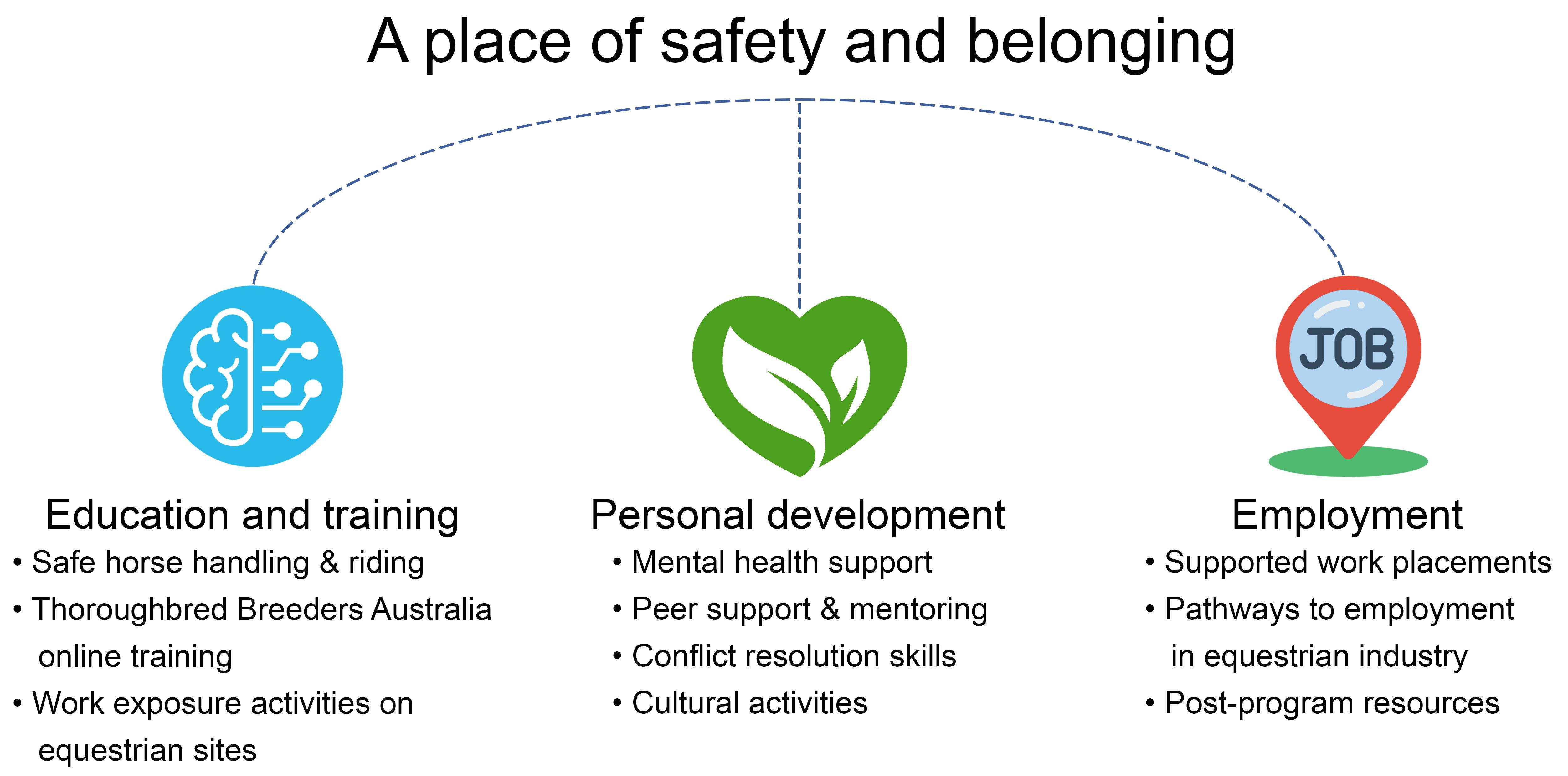
Lessons learned
Based on the three pilot cohorts and a completed program with young people in the youth-justice system, we have gathered feedback from participants, families and external support workers to begin to understand the impact of the program on young people’s lives. Young people tell us what is working and how they have begun to make positive changes.
Joining the EYES program was really exciting for me, and it has honestly met all my expectations – it’s been really good and very therapeutic. I’ve felt part of a community and have met amazing people. The workers treat me with respect, and I like the team we have. We all help each other. (Program Participant 1)
I’ve learnt so much about horsemanship, especially the importance of keeping a horse happy and comfortable. I’ve also started to understand my own emotions better – when I regulate myself, my horse responds differently, and that’s been really powerful to see. My riding skills have improved heaps too. (Program Participant 2)
Being part of this program has helped my confidence and mental health in a big way. When I’m riding, I stop thinking about all the other stuff that’s bothering me. It also keeps me out of trouble when I’m bored – now that I lease a horse, I spend my time doing something I love. The EYES program helped make that possible. (Program Participant 3)
What worked?
- Flexibility of staff to meet client needs (pick-ups, drop-offs).
- Providing breakfast before sessions to ensure young people are fed before physical activity – particularly beneficial as a distraction on bus journeys to Beverley, Western Australia.
- Involving support staff, particularly during early stages, to help clients feel comfortable in the group.
- Incorporating activity days throughout the program to build and develop group dynamic and to reward for engagement.
- Structured program modules, including Equus, RDA and industry visits, which supported engagement and skill development.
- Text message check-ins (as opposed to phones calls) outside of program days.
- Two blocks of riding lessons for young people, reinforcing practical skills, engagement and confidence.
- Strong partnerships and holistic case support are essential for sustained engagement.
- Flexibility in program delivery increases participant retention and outcomes.
- Ongoing family engagement strategies are needed to support participants at risk of disengaging.
Opportunities for improvement
- Introduce online theory modules at the start of the program (Weeks 2 and 3) to solidify the educational/theory aspect of the program;
- Include a Cultural Day program earlier in future groups to strengthen cultural engagement and learning;
- Clearly outline rider weight restrictions at the program’s outset to prevent disengagement due to unmet expectations; and
- Changes to transport, using two cars instead of a bus to mitigate anti-social behaviours.
The Foundation has partnered with the Centre for Social Impact (University of Western Australia) to develop a social impact evaluation plan designed to measure and understand the effects of the program. This includes setting clear evaluation goals/objectives and a ‘theory of change’, program logic and an evaluation plan developing indicators, metrics and data collection methods.
Measures will be taken at service commencement, and after each cohort of service delivery. A series of short, medium and long-term outcomes that align with individual, organisational and government priorities have been developed and a series of evaluation indicators that are measured by various means, including young person self-report, carer and external worker observations, attendance data, self-reported employment and recidivism status.
EYES appears to show promising early signs of making a significant difference for young people who face barriers to education, employment and social engagement. While participant attrition highlights the importance of addressing external factors, such as family support and health barriers, the program’s transformative impact on engaged participants underscores its value. By harnessing the power of equine-assisted learning and fostering strong partnerships, EYES offers a sustainable model for changing the negative life circumstances for young people in the justice system.
References
Australian Institute of Health and Welfare (AIHW). (2024). Youth detention population in Australia 2024. Canberra, Australia: AIHW. aihw.gov.au https://www.aihw.gov.au/reports/youth-justice/youth-detention-population-in-australia-2024/contents/summary/first-nations-young-people-in-detention
Baidawi, S., & Sheehan, R. (2019). ‘Crossover kids’: Offending by child protection-involved youth. Trends & Issues in Crime and Criminal Justice. No. 582. Canberra, Australia: Australian Institute of Criminology. DOI https://doi.org/10.52922/ti04138
Simmons-Horton , S. Y. (2021). ‘A bad combination’: Lived experiences of youth involved in the foster care and juvenile justice systems. Child and Adolescent Social Work Journal, 38(6), 583–597. DOI https://doi.org/10.1007/s10560-020-00693-1