

Article type: Original Research
2 July 2026
Volume 48 Issue 1
HISTORY
RECEIVED: 26 November 2025
REVISED: 23 June 2026
ACCEPTED: 25 June 2026
Article type: Original Research
2 July 2026
Volume 48 Issue 1
HISTORY
RECEIVED: 26 November 2025
REVISED: 23 June 2026
ACCEPTED: 25 June 2026
![]() ‘Why was I left to deal with this all on my own?’ Becoming allies with children to prevent sexual abuse
‘Why was I left to deal with this all on my own?’ Becoming allies with children to prevent sexual abuse
Emma Rees1 PhD * 
Affiliations
1 School of Public Health and Social Work, Centre for Justice, Queensland University of Technology, Brisbane, Qld 4000, Australia
Correspondence
*Dr Emma Rees
Contributions
Emma Rees - Study conception and design, Acquisition of data, Analysis and interpretation of data, Drafting of manuscript
Emma Rees1 *
Affiliations
1 School of Public Health and Social Work, Centre for Justice, Queensland University of Technology, Brisbane, Qld 4000, Australia
Correspondence
*Dr Emma Rees
CITATION: Rees, E. (2026). ‘Why was I left to deal with this all on my own?’ Becoming allies with children to prevent sexual abuse. Children Australia, 48(1), 3102. doi.org/10.61605/cha_3102
© 2026 Rees, E. This work is licensed under the terms of a Creative Commons Attribution 4.0 International Licence









Abstract
The social and political commitment to preventing child sexual abuse is reflected in an improvement in societal responses over the past 50 years, credited to public policy, social awareness and protective action by parents and caregivers within and beyond the home. However, despite evidence of progress, the prevalence of child sexual abuse remains relatively stable, indicating there is a persistent inability to prevent individuals from sexually abusing children. The responsibility for preventing child sexual abuse is predominantly located within policing, criminal justice and child protection systems and, to a far lesser extent, medical and education systems. To supplement these efforts, there has been an impetus toward expanding the awareness and knowledge of the population to encourage more active participation in prevention. The Royal Commission into Institutional Responses to Child Sexual Abuse and public health prevention strategies have contributed to an improved community awareness and knowledge. Nonetheless, a persistent ‘ick factor’ surrounds the issue of childhood sexual abuse as an ongoing social taboo. If the population were willing to acknowledge or discuss child sexual abuse, they would be more likely to take personal responsibility for it and actively respond. This is consequential because individuals who sexually abuse children do so due to social ignorance, silence and disbelief. Therefore, those who are resistant to acknowledging or discussing child sexual abuse are unwittingly complicit in it. This article shares the findings of a qualitative, feminist poststructural inquiry that centred the lived experience of fourteen adults who had experienced child sexual abuse in different community and familial contexts in Australia, attending to the intersecting social, cultural and structural conditions that shaped those experiences. Of particular interest were the actions and responses of members of the participants’ support network when they were children. Importantly, this research found that there were opportunities for family, community members and professionals to identify when an individual was sexually abusing them, to intervene, stop the harm and protect the child, yet they did not do so. A qualitative, poststructural feminist research methodology enabled the critical analysis of the participants’ accounts. This revealed how abuse is sustained through gendered discourses, institutional silences and power relations. The subtle operation of power through language, norms and systems was revealed to open space for ethical, empowering responses that support agency, voice and transformation. The focus on allyship reflected the author’s practice experience and the difficulties of safeguarding children from child sexual abuse in the constraints of neoliberal procedures and processes in statutory child protection systems.
To supplement the progress that has been made due to developments in policy and practice, this study proposes that individuals in the community need to take more responsibility for the prevention of, and responses to, child sexual abuse, which is conceptualised through the idea of being an ally.
Keywords:
ally, allyship, bystander, child protection, child sexual abuse, child sexual exploitation, DARVO, denial, feminist research, social work.
Introduction
Academics and politicians are confident that the societal response to child sexual abuse has vastly improved over the last 50 years (National Office for Child Safety, 2021). These improvements are attributed to public policy, social awareness, and protective action by parents and caregivers within and beyond the home (Harris et al., 2024; Mathews et al., 2024; Rayment-McHugh & McKillop, 2025; Vosz et al., 2023). The Australian Child Maltreatment Study provided evidence of these improvements when the experiences of different age groups were compared. A comparison of the experiences of people aged 45+ years with those aged 16–24 years showed the prevalence of child sexual abuse by fathers (biological/adoptive), male relatives who lived/did not live in the child’s home and other known adults had halved, and the prevalence of child sexual abuse by male siblings had more than halved (Mathews et al., 2024). However, the Australian Child Maltreatment Study also reported that 28.5% of the general population of Australia experienced childhood sexual abuse and these prevalence rates were consistent with those estimated in Australian academic studies since the 1980s (Mathews et al., 2024). Consequently, despite evidence of progress, the prevalence of child sexual abuse remains relatively stable, indicating there is a persistent barrier to prevent individuals from sexually abusing children.
The responsibility to prevent and respond to child sexual abuse currently rests within policing, criminal justice and child protection systems and, to a far lesser extent, within medical and education systems. The allocation of responsibility into these systems is the outcome of constructions and definitions of child sexual abuse in discourse. Discourse refers to ‘the sets of language practices’ (Healy, 2022: p. 3) or ‘clusters of ideas’ (Lovett et al., 2018: p. 6) that shape the ways we talk about, think about and respond to child sexual abuse (Healy, 2022; Lovett et al., 2018). Over time, in dominant discourses, child sexual abuse has been constructed as a biomedical and psychiatric issue, a crime, as a problem for social science and, more recently, as a public health issue. However, whilst child sexual abuse has a significant impact on the community, it is not considered a community issue or responsibility, and large sections of the community are excluded from existing prevention strategies. This article shares the findings of a qualitative, feminist poststructural inquiry that centred the lived experience of fourteen (n=14) Australian adults who had experienced child sexual abuse in different community and familial contexts. Of particular interest were the actions and responses of members of the participants’ support network when they were children. Importantly, this research found that there were opportunities for family, community members and professionals to identify when an individual was sexually abusing them, to intervene, stop the harm and protect the child, yet they did not do so. The reasons why they did not act were considered.
Over the past decade, there have been extensive efforts to implement public health preventative frameworks to tackle child sexual abuse (Quadara, 2019). The objective of these frameworks is to embed prevention activities in the whole population through existing universal services, community-based actions and population-wide strategies (Harris et al., 2024; Higgins et al., 2019). This approach has led to positive developments in population-focused prevention. The design and implementation of situational crime prevention techniques and contextual safeguarding are established primary prevention strategies that began in the early 2000s (Firmin & Rayment-McHugh, 2020; Wortley & Smallbone, 2006). Contemporary education of children includes important and relevant content, such as teaching body ownership, acceptable types of touch, the importance of disclosure, peer support and how to recognise harmful situations (Harris et al., 2024; Kenny et al., 2020). The first perpetrator-focused prevention strategy, ‘Stop it Now Australia’, designed to stop child sexual abuse before it occurs, was launched in 2022 (McKillop & Rayment-McHugh, 2022). However, even with these positive measures, social policies and strategies to tackle child sexual abuse still predominantly occur through policing, criminal justice and child protection systems (Austin & Salter, 2023; Lussier et al., 2021). These responses remain focused on victim–survivors and perpetrators, therapeutically or punitively (Quadara, 2019). Consequently, the role of family, community members and professionals is reduced to reporting to agencies of the state through mandatory reporting (generation FIVE, 2017). In fact, Australian states and territories extended the legal obligations to report child sexual abuse in recent years, with the introduction of failure to report, or concealing child abuse, as an offence. Now, every adult, even those who do not work in close contact with children, has a legal obligation to report current or historic child sexual abuse to police (see Australian Capital Territory Government, 2019; New South Wales Health, 2023; Queensland Government, 2025). Failing to report child sexual abuse in Queensland, for example, can result in a maximum penalty of 3 years imprisonment (Queensland Government, 2025). However, the continuing focus on policing, criminal justice and child protection systems as the primary prevention and response mechanisms in academia and social policy has limited efficacy, in part due to the influence of dominant discourses that emerged from European medical theories that had a significant influence on perceptions of victims and perpetrators (Featherstone, 2021; Harsey & Freyd, 2020; Rind, 2023).
Using the term paedophile to label all men who sexually abuse children has served as a powerful discursive strategy to distort the broader and more diverse identities of perpetrators (Harsey & Freyd, 2020; Nelson, 2016;). Originally, Freud’s theories contributed to dominant discourses that portray women and children as fantasists, liars or being responsible because they seduced perpetrators (Dominelli, 1986; Featherstone, 2021; Lovett et al., 2018). These discourses have shaped and remain embedded within institutional and social responses to child sexual abuse (Lovett et al., 2018; Tucker, 2023;). Discourses are historically contingent (Foucault, 2009): what is considered ‘normal’ or ‘true’ in one era may be radically different in another (Foucault, 2009; Powell, 2012). However, the essence of previous dominant discourses may be reframed using contemorary concepts or language that retain their resonance. The influence of dominant discourses is evident in institutional responses to child sexual abuse in legal and child protection systems, leading to unintended consequences.
Prosecuting child sexual abuse in contemporary legal systems is challenging; conviction rates are low, and survivors often experience harm when they participate in the process (Cashmore et al., 2020; Harris et al., 2024). The impact of punitive sentences, sex offender registration and monitoring strategies create the very conditions for an increased risk of re-offending and are, therefore, counter-productive strategies (Harris et al., 2024). Child protection systems disrupt family lives and connections while rarely creating safety for sexually abused children in the process (Cant, 2021; Dettlaff et al., 2020; Rogowski, 2025). In this way, strategies designed to promote community safety have ultimately hindered that goal (Harris et al., 2024). As an alternate approach, and to supplement the progress that has been made due to developments in policy and practice, the present study proposes that individuals in the community need to take more responsibility for the prevention of, and responses to child sexual abuse, which is conceptualised through the idea of being an ally.
Bishop (2002) adopted the term ‘ally’ to describe the actions that can be taken to tackle oppression. When an individual sexually abuses a child, this is an abuse of power enacted through a sexual act; therefore, it is an act that oppresses children (Feehan et al., 2010). Lawford-Smith & Tuckwell (2024) extended this conceptualisation. When an individual is privileged on the same axis on which an individual or member of a group is oppressed, and takes resistant actions that are authorised by the group member and are a product of appropriate deference to the group member to improve their position, they are an ally (Lawford-Smith & Tuckwell, 2024). To act as allies, family, community members and professionals must be equipped with the skills and knowledge to take resistant action to protect children and support adult survivors. There has been no prior academic literature that applies the idea of being an ally to child sexual abuse. Instead, the term bystander has been adopted as the vernacular in violence prevention literature, practice and in everyday language.
A ‘bystander’ is an individual, or group of individuals who are present in the lives of either the perpetrator, victim or both (Banyard, 2015). They make a choice either to recognise signs of violence, step in and help, or they encourage violence by simply observing it, or through denial and/or minimisation of the signs and symptoms of violence (Banyard, 2015). However, research that has applied bystander theories to child sexual abuse are minimal and outdated (see Christy & Voigt, 1994; Cismaru, 2013; Hoefnagels & Zwikker, 2001; Klebanov & Katz, 2023). Unlike other forms of violence, child sexual abuse does not occur in public, so it is rarely witnessed by bystanders (Gerke et al., 2021). It frequently occurs in families, reflecting unique relationships and dynamics between the child, perpetrator and the bystander (Klebanov & Katz, 2023). Hence, bystander theories and bystander intervention training is likely to be insufficient in encouraging the community to assume a role in the prevention and response to child sexual abuse. Consequently, the idea of being an ally was adopted.
The focus of academic literature on disclosure is relevant to this study because it relates to social responses to children who are sexually abused. Disclosure is the first scenario in which a child or adult survivor tells another person about sexual abuse (Ullman, 2003). A significant body of research has explored adult responses to children’s disclosures of child sexual abuse since the 1990s (see Allnock & Miller, 2013; Bradley & Wood, 1996; Rotenburg, 1995). Recent Australian research identified that when children were sexually abused, almost half of them (45.2%) never tell anyone anything about their experience (Mathews et al., 2025). However, another recent study found non-offending adults did not notice the signs of sexual abuse, and they did not listen to, or hear, children who tried to communicate what was happening to them (McPherson et al., 2025). This latter research shows how the focus on children, the reasons why they do not disclose and the barriers that prevent them from doing so, is misplaced. The problem is not that children face too many barriers to disclose, so decide not to; rather, that adults do not see the signs of abuse, or listen to children who are trying to communicate what is happening to them, and they do not ask children directly about sexual abuse (Glinski & Sabin, 2025; London et al., 2005; McPherson et al., 2025; Royal Commission into Institutional Responses to Child Sexual Abuse, 2017). Introducing the idea of allyship re-directs the discussion from children and their disclosures to the action or inaction of adult members of the child’s support network. As allies, community members must understand the dynamics of sexual abuse, identify the signs and know how to talk to children about sexual abuse, and respond when they notice signs of sexual abuse, or receive a disclosure (Glinski & Sabin, 2025; Royal Commission into Institutional Responses to Child Sexual Abuse, 2017).
There has been an impetus toward expanding the awareness and knowledge of the population to encourage more active participation in prevention. The Royal Commission into Institutional Responses to Child Sexual Abuse and public health prevention strategies have contributed to an improved community awareness and knowledge. Recent research found that when surveyed, the community exhibited sound knowledge concerning: the prevalence of child sexual abuse of boys and girls; the identity of perpetrators; and the locations where children are at risk of child sexual abuse (National Centre for Action on Child Sexual Abuse, 2024). However, even though the Australian Child Maltreatment Study found that almost 30% of the population experience child sexual abuse, and one in five (19.6%) of Australian men expressed having sexual thoughts about children or admitted harming children, the community attitudes survey reflected entrenched denial (Haslam et al., 2023; Salter et al., 2023). Of survey participants, 61% thought that child sexual abuse did not directly impact them or they were neutral, and 56% did not agree that child sexual abuse happens in the area where they live (National Centre for Action on Child Sexual Abuse, 2024). A persistent ‘ick factor’ (Innes, 2024: p. 464) surrounds the issue of childhood sexual abuse as an ongoing social taboo. Adults with lived experience of child sexual abuse are prevented from speaking openly about their experience in the community because of the function of stigma and shame (Kennedy & Prock, 2018; MacGinley et al., 2019; McRobert, 2022). Hence, these experiences remain hidden because people simply do not talk about child sexual abuse, and they lack the skills and confidence to do so (Dominelli, 1986; Glinski & Sabin, 2025; Nurse, 2020). Furthermore, bystander theory acknowledges that individuals or groups of individuals will not act to disrupt violence if they do not know how to act (Christy & Voigt, 1994; Hoefnagels & Zwikker, 2001; Klebanov & Katz, 2023; Latane & Darley, 1968). While child sexual abuse remains a subject that the population are resistant to acknowledge or discuss, they will be unlikely to take personal responsibility and actively respond to it. This is consequential because individuals who sexually abuse children do so due to social ignorance, silence and disbelief; therefore, those who are resistant to acknowledging or discussing child sexual abuse are unwittingly complicit in it (Salter & Woodlock, 2023). Denial, silence and resistance must be overcome to mobilise the community as allies to children and adult survivors. There is great promise in the idea that a community of allies will prove to be an effective prevention mechanism that will support the progress that has been made through recent developments in policy and practice.
Conceptual background
This project emerged from a particular problem – the social work practice response to sexually exploited children and young people. Early iterations of research design sought to understand if child protection practitioners’ lack of knowledge, specialist skills, practice tools and procedures could be improved, leading to the better protection of children and young people who were being sexually exploited. However, as the research project progressed, the focus of the project extended. It became apparent that, like child protection practitioners in statutory practice, family, community members and even trained professionals in universal services did not act when perpetrators subjected children to a broad range of sexual abuse and exploitation. Consequently, the focus of the research expanded beyond the initial problem and the research questions that the project sought to answer are as follows:
- What opportunities are there for family, community members and professionals to prevent, intervene in and protect children who are subjected to sexual abuse?
- What prevents family, community members and professionals from allying with child victims and adults with lived experience of sexual abuse in childhood?
A poststructural feminist theoretical framework guided the research process, inviting an openness to curiosity, uncertainty and an iterative and flexible approach, hence the extension of the initial focus of the research (Brooks & Hesse-Biber, 2007; Kelly, 2020). Theoretical feminist perspectives are useful for thinking about the causes of child sexual abuse, and the ways that the problem has been constructed, understood and responded to (Tucker, 2023). Feminist poststructural theory offers a critical lens to examine how abuse is sustained through gendered discourses, social and institutional silences and power relations. When the discourses and language that we use reflect the perspectives of dominant groups, the knowledge and power that serves these groups is maintained, and other systems of thought are excluded (Fook, 2023). The approach opens space for resisting and reconfiguring oppressive practices.
Method
Feminist research processes require ‘deep listening’ (Hesse-Biber, 2007: p. 159) to the voices of individuals usually excluded from the production of knowledge. Therefore, lived experience was the focus. Without the knowledge of adults with lived experience, the efficacy of research findings could be undermined because any recommendations for changes to social, policy or practice would be based on an interpretation of the needs of sexually abused children, rather than gaining an understanding of what survivors need based on their experience (Salter et al., 2019). Individuals with lived experience of traumatic life events describe benefits from their participation in research. They can talk about their experiences without risks or consequences, feel heard and can use their experiences to help others. Some survivors who participated in research even reported finding the interview process personally helpful, healing and insightful (Dragiewicz et al., 2023; Mortimer et al., 2021). However, this type of research is ethically high risk because participants might experience harm or discomfort as an outcome of participation and experience detrimental consequences (National Health and Medical Research Council, 2025). Consequently, the research design incorporated robust processes to minimise these risks.
To conduct the research in a trauma-informed way, the appropriate method was to question the participants through the medium of conversation (Campbell et al., 2019; Hesse-Biber, 2007). The relatively informal atmosphere of a conversation gives the participant choice and control over what they talk about and how they choose to do so (Death et al., 2020). Deep and active listening techniques were used with empathy and compassion to validate the participants’ feelings and choices while emphasising their strengths and resilience (Campbell et al., 2019; Fraser & Taylor, 2020). The risks were discussed with participants, a distress protocol was in place and all participants were provided access to free psychology, family therapy or counselling services through the university, if needed.
This was an exploratory research study in relation to the specific experience of a population of adults, and therefore purposeful sampling was required (Alston & Bowles, 2018). This was a hard-to-reach population, consequently a range of recruitment materials and processes were required (Fraser & Taylor, 2020). Corresponding ethics variance requests were made to reflect changing recruitment strategies with the same approval number. During recruitment, eligibility was based on the following criteria: for participants to be over 18 years of age, have experienced child sexual exploitation and be proficient in the English language. Consequently, recruitment materials were heavily focused on describing and explaining child sexual exploitation. Resources included a flyer, participant information sheet, website and a recruitment video, which were distributed on online platforms through partners in non-governmental organisations working in the field of child protection, and with the support of academics. As recruitment progressed, it quickly became apparent that those nominating to the research briefly described experiences that could be categorised as either child sexual exploitation or child sexual abuse. Therefore, a pragmatic approach was taken. If the language of the child sexual exploitation resonated with the experience of the potential participant, and if, after explaining the terminology during information and screening conversations, the participants nominated themselves to participate, then they were considered eligible. As a result, none of the participants had an experience that reflected the scenarios described on the flyer.
Saturation refers to the point during data analysis when interviews produce no new, useful information in relation to the research questions (Guest et al., 2020). After research conversations with fourteen participants, consistent responses and themes were observed in fieldwork memos, indicating that no new information was being attained to warrant further recruitment and data collection; hence, saturation had been met.
The participants came from all over Australia and participated via phone conversations, Zoom calls or face-to-face conversations. These conversations were digitally recorded by a handheld device either during face-to-face meetings or during phone calls on speaker. The digital files from these recordings and Zoom calls were downloaded, securely stored and deleted from devices. The recordings were personally transcribed by the researcher using a line-by-line transcription and analysis process (Fraser, 2004). All identifying details were removed from the transcription and a pseudonym was used. The participants checked transcriptions for accuracy if they wished to do so. The data were analysed using thematic analysis (Braun & Clarke, 2006) informed by poststructural feminist theory and critical discourse analysis (Garrity, 2010).
The project received ethics approval from the Queensland University of Technology Human Research Ethics Committee, number 4229.
Results
A significant finding that emerged from the data analysis was that members of the child’s support network could and should have identified that they were experiencing child sexual abuse, intervened, stopped the harm and protected the child. However, these individuals did not do so. Critical discourse analysis indicated that this inaction was influenced by dominant discourses that deflect responsibility from perpetrators and institutions, deny or minimise harm, or cause children to be disbelieved or blamed for their own sexual abuse (Lovett et al., 2018). The contemporary relevance of dominant discourse and constructions was considered and will be reflected in the discussion of the data.
The data presented describe the opportunities that were in place for members of the child’s support network to identify harm, intervene and protect the child. This is followed by a discussion pertaining to the barriers that prevented these individuals from intervening. All the participants, who were assigned a pseudonym, were asked whether there was anyone who could or should have helped them when they were children. Ten of the fourteen participants asked someone for help, sometimes more than once, other participants showed clear signs of harm. Emily, Kathy and Hayley were the only participants for whom there were no such opportunities.
One of the participants, Liz, received support from an ally. When she was 4 years old, a young man who was working on the family property frequently sent Liz’s older brother to fetch her and bring her to the wool shed so he could sexually abuse her. On one occasion, Liz’s grandfather observed her distress and realised what caused it.
I happened to be with my grandfather, and this young man sent my brother to fetch me and I said, ‘I didn’t want to go,’ and started crying. And my vague memory of my grandfather [was him] saying, ‘You don’t have to go if you don’t want to’. And that’s when he twigged.
Liz’s grandmother asked her gentle questions in conversation to determine what caused her distress, then her father took the man out to the paddock and beat him, so he did not hurt Liz again. Unfortunately, although these actions kept Liz safe, she was aware that this perpetrator went on to hurt other children. Liz’s safety was short-lived. When she was 8 years old, an older boy, who was the son of family friends, started to sexually abuse Liz during visits to her home. During school holidays, Liz was sent to stay with this boy and his family where he continued the abuse. To make him stop, Liz told his mother but was unprepared for the boy’s mother to respond the way that she did.
I went to her and told her, and she immediately called him in. And asked him if that happened, of course he said no. She attacked me, in front of him as well … But even more damaging than the actual sexual abuse, was the way his mother reacted. Called me a liar, called me … oh you’ve got no idea. And I was just shattered. I couldn’t talk to anybody.
Of course, it would be extremely difficult for a mother to believe that her son would harm another child in this way. However, in response to the mother’s reaction, Liz felt shame and feared that others might also disbelieve her. She was unable to seek support from her family and therefore did not tell anyone else about this child’s behaviour until almost 10 years ago. Liz’s example demonstrates how difficult it can be for family members to intervene when a child is sexually abused in a familial context. Three other participants, Malana, Steph and Annie, were sexually abused by their fathers, who allowed other men to sexually abuse them too.
This abuse occurred in the context of a nuclear family; their mothers and siblings also resided with them, yet their mothers did not or could not protect them. There were significant differences in the place, culture and socio-economic circumstances in the participants’ backgrounds, and their experiences occurred at different times. Nonetheless, these fathers subjected them to significant and sustained sexual abuse, including that which could be described as rape and torture.
Malana’s mother knew about her father’s abuse, because she asked her for help when she was a child.
I worked up the courage to say to her the phrase, ‘He makes me touch him’. And … she … didn’t even look at me or turn around. We were just walking. I was holding onto her hand, and she just said, ‘Well, tell him to stop then’.
This response had a significant impact on Malana.
I knew from then on, that my death warrant was signed, and that never again would I be able to rely on telling her anything and that I was in this on my own.
Malana explained that her mother’s words and inaction represented a betrayal.
… a big betrayal from the mother and … traitor.
When Steph tried to talk to her mother about her father’s abuse, she got angry, so Steph learnt not to make a fuss about it. Over time, Steph explained that her mother became directly involved in the ‘business’ of organised child rape that operated from her family home.
… [She was] literally counting out the money, [while] she’s sitting in the garden … laughing and drinking while I’m getting assaulted by someone in the bathroom.
This involvement meant that Steph’s mother actively enabled the concealment of the child sexual abuse within the family, helping to preserve both the secrecy and the family structure. After enduring significant and persistent violence and abuse from her father, Steph described her mother’s complicity as ‘… the deepest wound’.
Annie did not know if her mother was aware of her father’s abuse or not, but she described her father’s home as ‘his castle’ at a time when ‘the father can do what he wants’ and ‘if you didn’t like it, you were overreacting and you had a problem’. Annie’s father controlled and dominated the whole family using deadly violence. She recalled one occasion when her mother was pregnant, and her father decided that the baby was not his.
He had her outside with a shotgun at her head. He was going to shoot her, so we were all screaming and carrying on.
Annie’s mother struggled with her own childhood trauma and addictions, so it would be unlikely that she could intervene in Annie’s father’s behaviour due to his domination and control even if she was aware.
Steph and Malana did not know why their mothers did not protect them, even though they knew that their fathers were causing them significant harm. It is likely that they were unable to do so because these fathers dominated their homes and family members using violence. Without disagreeing with, or minimising Malana’s perception that her mother was a traitor, there is an indication that she did not know what to do to stop her husband from harming her child. Malana’s mother disclosed the abuse to her own father, Malana’s grandfather.
She did go and tell my grandfather, her father, and all that happened was my grandfather went to my father and said, ‘Do you know you could go to jail for doing that?’ And then that was it.
Unfortunately, despite seeking help from her parents, Malana’s mother’s disclosure and her grandfather’s response did not stop Malana’s father from subjecting her to child sexual abuse for the duration of her childhood.
Two other participants experienced child sexual abuse in their home environment but the individual responsible was an older brother. Lily and Renee’s older brothers asserted their dominance over their younger siblings using physical violence. They manipulated the family dynamics, particularly their relationships with their mothers, to hurt them. Renee was unable to ask anyone for help because she could not articulate what was happening to her, but since Lily’s parents failed to recognise what her brother was doing in the home, she asked a priest for help.
I actually asked the priest to help. I actually went to confession, and I asked him to stop my brother, and he just told me I was bad and gave me my prayers and that was it. And he knew me; he could’ve helped, and he didn’t help.
Annie described a similar experience because she too requested help from a priest. Her father sexually abused, raped and tortured her and her siblings and allowed others (including priests from the local Catholic church) to do so too. However, similarly, the priest refused to hear the allegation or intervene.
The priest was going to help you. The priest was someone you could trust. I went in, and I was really upset, and I told him what was going on. And his response … sorry even after all these years I can’t believe this is what he said. And he was a trained psychologist as well … He put his hands over his ears … he said, ‘Oh it hurts to hear such things about such beautiful people’.
Later, Annie told her general practitioner that her father was always watching her, like ‘a peeping tom’, but he did not ask questions or try to understand the problem, instead he prescribed medication.
Basically, I was telling him what was happening in my family life, and he, just decided that I was hallucinating. So … he thought I was imagining it, and I was actually describing what was happening.
By medicating Annie, rather than believing what she was saying, the doctor was prevented from intervening to protect Annie and her siblings.
Participants Grace, Jen and Mackenzie told a friend/s about what they experienced. Grace was ‘raped and sodomised’ by a farm worker on a family property. The day after, she informed her classmates at school.
I went to school and told my classmates what happened. And I said … ‘This guy had sex with me’. I was probably in year one.
Her classmates listened, believed her, and tried to help Grace by telling their parents; the outcome that Grace hoped for.
But I was telling my friends in part in hope that then they’d say something. They were all listening to me. And I said, ‘Oh good they believe me’.
However, the children’s parents did not believe Grace.
The next day, they, they came running up to me and they said, our mums said you’re making this up.
The impact of this disbelief meant that afterwards, Grace did not tell anyone else for years. She also sought help from the kid’s helpline when she was 15 or 16, but they did not believe her either.
Well, I did ring the kid’s helpline, but they didn’t help me. They seemed to think I was making it up.
Grace was denied opportunities to feel safe and access support due to this disbelief, and the perpetrator continued to harm other children.
Jen was being repeatedly abused by her neighbour after school when she was alone because her parents were working and her older brother was at high school. Jen told a teenager who was 4 years older than her when other friends were around. Unfortunately, this child was not equipped to respond appropriately nor were other children in the vacinity.
I can remember them laugh. I don’t know if they didn’t believe me, I don’t think they knew what to do.
Jen had hoped that something would change from this disclosure, but nothing did.
When Mackenzie was 15, her sports coach had sex with her after giving her a lift home from a nightclub. She was under the legal age of consent in any state in Australia, so the coach’s actions are statutory rape even if Mackenzie had expressed a willingness to have sex with him (which she did not). Mackenzie told her friend about the incident but, because she lived in a small town, a member of the perpetrator’s nuclear family members heard about her disclosure.
I did tell one friend, that friend told somebody else, and that person told his brother, who went to my school. His brother obviously spoke to his mum about it. His mum called … or his brother called and said, ‘Do you realise that he could go to jail? If you tell anyone, he’ll lie’.
The relative contacted Mackenzie, warning her that the coach was prepared to deny his actions to avoid being jailed. This caused Mackenzie to doubt the nature of her experience and blame herself.
At that point in time I don’t think I really recognised it as sexual abuse. I think it was, because I didn’t say no. And I sat with that for a really long time and thought, … well I shouldn’t have been at the nightclub, and I should’ve said no, that I didn’t want to go with him and I should’ve, you know, all of this victim blaming stuff.
This response and the associated self-blame silenced Mackenzie so she did not disclose again what had happened until she was in her early thirties.
Hollow Man’s experience of seeking protection from police reflected the innate tendency to assume that children are lying about their experiences. Abandoned by his mother into the care of a violent man, Hollow Man was starved, beaten, sexually abused, raped and tortured. When Hollow Man approached the police for help, the police officer initially suspected that he was lying.
Just after my 14th birthday. I had to do it one last time so I could get the evidence. And I took off in the middle of the night to the police station at about midnight or something. Smashed on the door because I knew the copper lived next door and told him. [He] tried to say, ‘If you’re lying, you’re going to be in trouble’. … I had to convince them I was telling the truth before they would do shit.
These examples illustrate the point made in the introduction (see McPherson et al., 2025), that children do try to seek help by telling someone what is happening to them, but the individuals they tell fail to respond appropriately. There was further evidence that even when the participants were unable to tell someone what was happening, there were clear signs of distress that should have warranted curiosity and a conversation between non-offending adults and children, enabling them to identify harm and act to protect the child.
Renee was sexually abused, raped and tortured by her older brother. When Renee was in year 2 or 3, she had trouble learning how to read and write, but her oldest brother flourished at school. He contrived to use Renee’s difficulties with reading to gain nightly access to her.
And my older brother, being so good at school and you know, being such a … nice person that he is, caring and all of that, he offered to tutor me.
Every night, with his parents believing that he was helping and supporting his sister to learn to read, he was subjecting her to child sexual abuse. Renee was unable to tell anyone what her brother was doing because he had already physically enforced his dominance over her, regularly inflicting Chinese burns, punching and causing dead arms. Furthermore, Renee could not articulate what was happening. Renee recalled trying to tell her mother that she did not want Ray to teach her to read but in doing so, she became very distressed and could hardly speak. Renee shared a drawing that captured her extreme distress and her mother’s response (she gave permission to share the drawing in this article; see Figure 1).
Figure 1. Renee’s drawing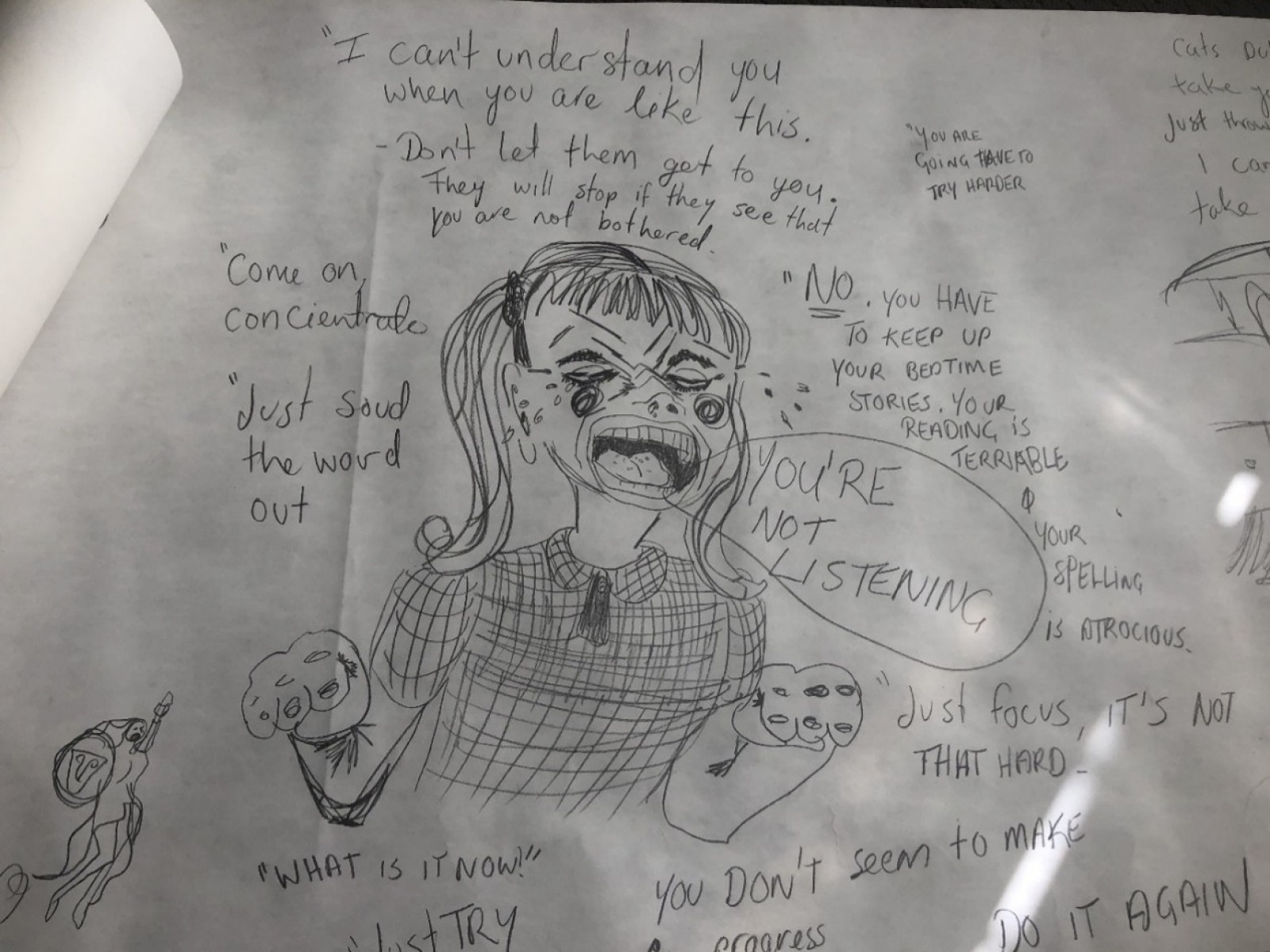
Renee believed that her mother misinterpreted the source of the distress because of a complete lack of awareness that older, male siblings can and will harm their younger sisters.
In my mum’s mind she would never in a thousand years think that … he would do that to me.
Unfortunately, Renee was an adult by the time she recognised that her brother’s actions were different from physical bullying and amounted to child sexual abuse. This discovery, and Renee’s decision to access legal processes has severed her relationship with her family.
Ben was bullied throughout his experiences at school, and there were difficulties in his relationship with his parents, who were hoarders. During a period of crisis, Ben contacted a friend and ran away from home to go and stay with her and her parents. Ben’s friend had another female friend staying with her, and when they were alone together, she asserted power over him, forcing him into unwanted sexual activity.
Everyone had gone to bed except me and this other girl. We were just watching TV. And then she started touching me; not inherently sexually to begin with but then it turned into that and then wanted me to do more things to her… I didn’t want to, and I tried to … I wanted to go but I … didn’t want to go home and I didn’t know where else I could be.
The parents of the girl whose home Ben stayed at informed his parents that he had sex whilst staying there. It is likely that, because of his gender, Ben’s parents would presume that he welcomed or instigated the sexual interaction. Ben acknowledged that he had not considered himself a victim at the time.
It’s possible, I don’t know. But at the same time … I never … suggested to anyone either that I was a victim.
Even if Ben had recognised that he had been a victim of sexual violence, and disclosed, it is unclear if he would have received support due to the assumption that he likely welcomed or instigated the sexual interaction.
As well as telling her classmates about her experience as outlined above, there were multiple indications that Grace had been seriously harmed. First, in the immediate aftermath, Grace bled through the night, and her mother saw blood in the bed, in her pyjamas and in the toilet. She contacted medical professionals for advice, but they decided that Grace had hurt herself on some play equipment. There was no medical examination or records taken in response to Grace’s mother’s inquiry. Second, Grace described how fearful she had been when she was taken on subsequent visits to the farm, but her father forced her to go, regardless. Unfortunately, her father assumed that she was fearful of going to the farm because her cousins told scary stories. He did not ask Grace why she was so scared. So, her experience remained secret, and the perpetrator continued his employment on the family farm where he continued to subject Grace’s older brothers and cousins to child sexual abuse, rape and torture. Third, Grace described a situation whereby the perpetrator, her uncle, her fathers’ first cousin and her father’s best friend were driving through a paddock in a utility vehicle. When the perpetrator saw Grace’s cousins up on the hill, he said, ‘Oh God, they’re sexy’. Grace reported that her father’s cousin thought that was a weird thing to say, but there was no follow up. Finally, after the incident at the farm, there were observable changes to Grace’s character and demeanour at school, too. Grace recalled ‘… all the fear coming in [her] life then’, and this fear influenced her personality and behaviour. Grace’s teacher observed these changes and as an adult, her teacher said to her ‘I always knew something had happened to you … You were a very troubled little child’. However, Grace’s teacher told her that she had felt unable to explore her concerns for her.
She said that she wasn’t allowed to ask me outright if anything had happened and she said she felt like, … I think it was something to the effect of it was against the law to ask me, or it wasn’t procedural or policy to ask me because she didn’t want to put words in my mouth.
At the time, teachers and other school staff were not mandated to report child maltreatment to child protection authorities, but since the introduction of mandatory reporting laws and policies, they would now be required to report their concerns. However, there is no certainty that a report to statutory services would result in this perpetrator being convicted and stopped from harming other children. Grace believes that the man who harmed her went on to harm between 33 and 36 other children, including Grace’s two older brothers and her cousins. These findings demonstrate that there were opportunities for members of the child’s support network to have identified that these children were being hurt and to have taken action to protect them and stop the perpetrators from harming other children. The reasons why these individuals did not act have been considered in relation to dominant discourses that influenced their responses. The contemporary relevance of these discourses are considered in the following discussion.
Discussion
Analysis of the participants’ accounts revealed that beliefs that are instilled and sustained by dominant discourses prevented members of the child’s support network from intervening. There have been significant socio-cultural and political changes since the participants were harmed. Nonetheless, discourses that dominated thinking in the past have shape-shifted (Lovett et al., 2018: p. 55), so despite being contested in contemporary research, they remain influential because they are embedded in institutional and social responses. This discussion will consider how dominant discourses shaped perceptions of perpetrators and children influencing the actions of family, community members and professionals. The contemporary relevance of these discourses will also be considered.
A man’s home is his castle
The data presented showed that Annie’s, Malana’s and Steph’s fathers, and Hollow Man’s carer, dominated their homes and family members using violence. The patriarchal structure of the family was an environment where they could exercise their dominance and harm their children without scrutiny from outside, and the participants’ mothers did not or could not prevent them from doing so. These experiences occurred in the 1960s and 1970s. Since then, feminist activism has challenged male dominance and violence in traditional family models by advocating for equality between men and women (DeRose et al., 2019; Oláh et al., 2020). This has led to the emergence of different family models in modern Australia. However, even when women have financial independence, parity or when women earn more than their partners, men are still able to assume a position of authority and entitlement due to gendered socialisation and dominant social norms (Fisher et al., 2025; Klein & Conley, 2022). Empirical evidence indicates that in Australia, ‘… women who earn more than their male partners are subject to a 33% increase in partner violence and a 20% increase in emotional abuse compared to mean levels’ (Zhang & Breunig, 2023: p. 2961). Consequently, regardless of improvements in gender equality, a significant number of women will be the victim of domestic and family violence in their lifetime (Brown, 2025). Men continue to use violence and maintain dominance over their family members, creating an opportunity for them to sexually abuse their children.
Mothers who do not protect their children, despite the constraints that they experience, can expect to be blamed, socially and in child protection and legal processes through the ‘failure to protect doctrine’ (Azzopardi, 2022; Kuskoff et al., 2024). Since new criminal offences were introduced in recent years, mothers who are blamed for failing to protect their children can now expect to be criminalised too. The first woman convicted for the failing to report child sexual abuse offence in Queensland was identified as the biological mother of a child who was sexually abused by her husband (Grimes, 2024). The woman had confronted her husband when she suspected that he was sexually abusing the child, but he assured her that ‘it was not what she thought it was’ (Grimes, 2024: para. 11). Academic research reveals that men who sexually abuse children in their family engage an extensive array of effective tactics to deceive. They also manipulate their power in the family while obscuring the mother’s perception of their behaviour and interfering in her relationship with their child (Laing, 1999; Laing et al., 2024). Therefore, the failure to report offences overlooks the ability of men to dominate and control their partners so they can sexually abuse children, while perpetuating mother-blaming.
Boys will be boys
Lily and Renee’s older male brothers also dominated the home environment using physical violence towards their siblings. Renee used the phrase ‘boys will be boys’ to describe the social acceptance that male children will be violent. An inability for parents to prevent their sons from physically abusing their siblings likely contributed to the subjection of Renee and Lily to harm at the hands of their older brothers. To challenge male violence and the aspects of traditional masculinity that are perceived to be detrimental to the health and wellbeing of men and boys, programmes that have been designed to promote ‘healthy masculinities’ are prolific (Flood et al., 2024: p. 595). Nonetheless, in conjunction with these types of violence prevention methods, boys are being peddled powerful, traditional constructions of masculinity through social media (Blower & Rainford, 2025; Thomas-Parr & Gilroy-Ware, 2024). The accessibility of pornography online is related to these images of traditional masculinity. Hence, when combined with the promotion of traditional masculinity and misogyny by influencers online, it is likely that pornography has a significant influence on boys’ sexual attitudes and behaviours (Blower & Rainford, 2025; Crabbe et al., 2024; Thomas-Parr & Gilroy-Ware, 2024). The increasing rates of sexual abuse by male, adolescent perpetrators in non-romantic relationships (Mathews et al., 2024) reflect the ongoing influence of dominant discourses that construct expectations of masculinity and they are reflected in the socialisation and behaviour of boys.
The paedophile construction: Ordinary men and good blokes are not perpetrators
The structure of the family protected those perpetrators who harmed other family members. For example, Annie and Lily sought help from priests whose responses reflect the tendency for Catholic institutions to prioritise patriarchal structures, such as the traditional family unit, over the visibility and needs of sexually abused children (Death, 2013). The detection, prevention and treatment of sexual abuse that occurs in the private realm of the family remains a major policy and practice challenge (Salter, 2020). The structure of the family gave Annie’s, Steph’s and Malana’s fathers a public persona of a family man and, therefore, they were considered, basically ‘good blokes’. Renee’s brother was able to leverage his success as a student and both Renee’s and Lily’s older brothers leveraged their authority as older brothers to gain access to their siblings for sex. Perhaps Hollow Man’s carer was considered a good bloke for taking him in and caring for him after his mother abandoned him. Paedophile constructions continue to distort reality by suggesting that perpetrators who harm children are one type of person, with one subjectivity – deviant and evil. Therefore, if a man possesses other subjective characteristics of being a ‘good bloke’ that do not fit with perceptions of the paedophile, they are not perceived to be capable of perpetrating child sexual abuse or deserving of punishment (McAlinden, 2014). When the priest criticised Annie for speaking ill of ‘such beautiful people’, he was demonstrating how discourses that distort the identity of perpetrators operate by making it difficult to acknowledge perpetrator behaviour when it is performed outside the limited framework and portrayal of the paedophile (Lovett et al., 2018; McAlinden, 2014).
Children lie
An enduring impact of the Freudian theory is that children desire, ‘imagine’ or make up incestuous relationships’ (Featherstone, 2021: p. 199). This theory initiated the dominant discourse that children lie, contributing to contemporary denial theories like false memory syndrome (McMaugh & Middleton, 2022; Salter & Blizard, 2022). The impact of this discourse is the embedded belief that children are capable of and are likely to make false allegations of sexual abuse (Lovett et al., 2018; Nelson, 2016). The data presented demonstrate how this discourse had a significant impact on some of the participants in this research. It is likely that several other factors occur alongside dominant discourses that influence people to disbelieve children and adults with lived experience. One is the ‘ick factor’ (Innes, 2024: p. 464), the taboo nature of child sexual abuse, and the discomfort that arises because no-one wants to believe that a child we know could be sexually abused, or that a person we know and love could sexually abuse a child (Nurse, 2020). The community has a good awareness and knowledge about child sexual abuse, yet their denial of it, and resistance to accept it means that it is appealing to lean into dominant discourses that support the belief that children and adults with lived experience lie about child sexual abuse.
The attention and activation of the whole community is needed for children and adult survivors to feel safe, and for action to be taken that will stop individuals from sexually abusing, raping and torturing children. To resist and challenge influential dominant discourses and empower family, community members and professionals to ally with children to prevent child sexual abuse, alternate ways to construct, understand and respond to child sexual abuse must be found.
Contribution to knowledge
The primary contribution that this research makes to knowledge is the theoretical construct of allyship. Allyship is about more than knowledge and awareness. There have been significant socio-cultural and political changes since the participants were harmed. Social awareness of child sexual abuse has significantly increased since the 1990s due to major scandals, government inquiries, widespread media coverage and legislative reporting initiatives (Mathews et al., 2024). Community members now have improved knowledge regarding the prevalence of child sexual abuse for boys and girls, the main types of perpetrators and the main locations where children are at risk of child sexual abuse (National Centre for Action on Child Sexual Abuse, 2024). Nonetheless, despite all of the socio-cultural changes and developments in theory and research that reflect changes in the nature of the abuse, there is evidence that family, community members and professionals still do not identify the abuse and intervene to protect children. Past discourses have shape-shifted (Lovett et al., 2018: p. 55) and have been contested in contemporary research, but they remain influential because they are embedded in institutional responses. Consequently, 80% of Australian adults have never discovered or received a child’s disclosure about child sexual abuse and, of those who have, less than half provided support to the child and/or reported to authorities (National Centre for Action on Child Sexual Abuse, 2024). Most community members reportedly didn’t know what to do or were not confident in acting or providing support if a child was to tell them, or if they discovered, a child was being sexually abused (National Centre for Action on Child Sexual Abuse, 2024). This tells us that further research is required to create knowledge to inform what family, community members and professionals need to know and do to act as allies, protect children and stop individuals from sexually abusing them.
Limitations
Unfortunately, it was not possible to recruit participants who live with disability, are from culturally and linguistically diverse communities, who identify as LGBTQI+ or Aboriginal and Torres Strait Islander peoples. This is a limitation because research indicates that members of these groups experience sexual violence at equivalent or higher rates and in different ways to other members of the Australian population (Salter et al., 2024). Therefore, the unique experiences, needs and insights of individuals from these marginalised groups are not represented in this research.
Due to the iterative nature of research that set out to explore child sexual exploitation as a social work problem, but instead gained broader insights into the (in)action of family and community members and professionals in institutions, the participants were not asked directly about being allies. It would have been beneficial to understand how the participants would conceive and describe the experience of having an ally in relation to their childhood circumstances and experiences, and this has been flagged for future research. Even though there were limitations, the research holds significant implications for policy and practice.
Conclusion
There have been significant socio-cultural and political changes since the participants were harmed. However, despite improved social awareness and knowledge about child sexual abuse, enduring dominant discourses and denial continue to impede the protection of children. This research has considered how the barriers that prevent intervention could be overcome so that the whole community could be activated as allies to children. The application of poststructural feminist theory revealed how patriarchal constructs of family roles and responsibilities as well as gender power relations and social norms prevent individuals from being allies. These constructs can be transformed when they are known and challenged by counter discourses.
Knowledge translation and impact
The findings in this article have implications for future prevention policy and community initiatives to ensure that children are protected from sexual abuse.
Acknowledgements
The author acknowledges the Traditional owners of the land on which this study took place, the Kabi Kabi and Jinibara peoples, and pays respect to all Elders past and present.
This article reflects findings from a study undertaken to fulfil the requirements of a Doctor of Philosophy qualification. The author thanks all the participants for their time, knowledge and bravery. Thank you to all the supervisors involved in guiding and supporting the project, Professor Christine Morley, Dr Joanne Clarke, Associate Professor Heather Fraser and Associate Professor Julie King. Finally, I thank professional editor, Mike Buky, who provided copy editing and proofreading services.
Reflexivity statement
The author is an experienced and qualified social worker who is female, white, a dual citizen of the United Kingdom and Australia and of English cultural heritage. The researcher has not been subjected to child sexual abuse or suffered from the long-term debilitating effects of childhood sexual violence. She experienced a safe and loving childhood, protected by nurturing adults and believes that all children have the right to be safe, loved and protected. The design and conduct of the study were informed from this position and with this motivation.
Funding statement
This research was financially supported by the Commonwealth Government through the provision of a Research Training Program Stipend and an Australian Government Research Training Program Scholarship.
Conflicts of interest
There are no conflicts of interest identified by the author.
References
Allnock, D., & Miller, P. (2013). No one noticed, no one heard. A study of disclosures of childhood abuse. London, UK: National Society for the Prevention of Cruelty to Children. learning.nspcc.org.uk https://learning.nspcc.org.uk/research-resources/2013/no-one-noticed-no-one-heard
Alston, M., & Bowles, W. (2018). Research for social workers: An introduction to methods. Taylor & Francis. DOI https://doi.org/10.11157/anzswj-vol30iss3id549
Austin, K., & Salter, M. (2023). Policy barriers to child sexual abuse secondary prevention programs in Australia. Journal of Sexual Aggression, 30(3), 481–495. DOI https://doi.org/10.1080/13552600.2023.2212001
Australian Capital Territory Government. (2019). All adults must report child sexual abuse. Factsheet. Canberra, Australia: ACT Government. act.gov.au https://www.act.gov.au/__data/assets/pdf_file/0007/1397662/Failure-to-Report-Offence-Royal-Commission-Criminal-Justice-Legislation-Amendment-Act-2019.pdf
Azzopardi, C. (2022). Gendered attributions of blame and failure to protect in child welfare responses to sexual abuse: A feminist critical discourse analysis. Violence Against Women. 1631–1658. DOI https://doi.org/10.1177/10778012211024263 PMid:34515580
Banyard, V. (2015). Toward the next generation of bystander prevention of sexual and relationship violence: Action coils to engage communities. Springer International Publishing. DOI https://doi.org/10.1007/978-3-319-23171-6
Bishop, A. (2002). Becoming an ally: Breaking the cycle of oppression in people. Routledge.
Blower, A., & Rainford, J. (2025). The problem with boys? Teacher's engagement with masculinity, mental health and the manosphere in the school classroom. Open Research Online. oro.open.ac.uk https://oro.open.ac.uk/105252/
Bradley, A., & Wood, J. (1996). How do children tell? The disclosure process in child sexual abuse. Child Abuse & Neglect, 20, 881–891. DOI https://doi.org/10.1016/0145-2134(96)00077-4 PMid:8886473
Braun, V., & Clarke, V. (2006). Using thematic analysis in psychology. Qualitative Research in Psychology, 3(2), 77–101. DOI https://doi.org/10.1191/1478088706qp063oa
Brooks, A., & Hesse-Biber, S. N. (2007). An invitation to feminist research. Feminist research practice: A primer. SAGE Publications Inc. 1–12. DOI https://doi.org/10.4135/9781071909911 PMid:24747286
Brown, R. (2025). Crime & justice research 2025. Canberra, Australia: Australian Institute of Criminology. DOI https://doi.org/10.52922/sp77765
Campbell, R. G. (2019). A trauma-informed approach to sexual violence research ethics and open science. Journal of Interpersonal Violence, 34, 4765–4793. DOI https://doi.org/10.1177/0886260519871530 PMid:31514606
Cant, R. (2021). A mixed methods approach to increasing understanding about reported sexual abuse of children in Western Australia 1990–2009. The University of Western Australia. DOI https://doi.org/10.26182/4sb6-7j23
Cashmore, J., Taylor, A., & Parkinson, P. (2020). Fourteen-year trends in the criminal justice response to child sexual abuse reports in New South Wales. Child Maltreatment, 25(1), 85–95. DOI https://doi.org/10.1177/1077559519853042 PMid:31167548
Christy, C., & Voigt, H. (1994). Bystander responses to public episodes of child abuse. Journal of Applied Social Psychology, 24(9), 824–847. DOI https://doi.org/10.1111/j.1559-1816.1994.tb00614.x
Cismaru, M. (2013). Encouraging bystanders to help in stopping violence against children. International Journal of Nonprofit and Voluntary Sector Marketing, 18(1), 7–17. DOI https://doi.org/10.1002/nvsm.1451
Crabbe, M., Flood, M., & Adams, K. (2024). Pornography exposure and access among young Australians: A cross-sectional study. Australian and New Zealand Journal of Public Health, 48(3). DOI https://doi.org/10.1016/j.anzjph.2024.100135 PMid:38508985
Death, J. (2013). Identity, forgiveness and power in the management of child sexual abuse by personnel in Christian institutions. International Journal for Crime, Justice and Social Democracy, 2(1), 82–97. DOI https://doi.org/10.5204/ijcjsd.v2i1.92
Death, J., Moore, T., McArthur, M., Roche, S., & Tilbury, C. (2020). Young people's perceptions of sexual assault in residential care: “It does happen a lot”. Journal of Child Sexual Abuse, 30(1), 4–20. DOI https://doi.org/10.1080/10538712.2020.1715521 PMid:32045343
DeRose, L. F., Goldscheider, F., Brito, J., Salazar-Arango, A., Corcuera, P., Corcuera, P. J., & Gas-Aixendri, M. (2019). Are children barriers to the gender revolution? International comparisons. European Journal of Population, 35(5), 987–1021. DOI https://doi.org/10.1007/s10680-018-09515-8 PMid:31832033
Dettlaff, A. J., Weber, K. P. M., Boyd, R. B. B., & Burton, L. (2020). It is not a broken system, it is a system that needs to be broken: The upEND movement to abolish the child welfare system. Journal of Public Child Welfare, 14(5), 500–517. DOI https://doi.org/10.1080/15548732.2020.1814542
Dominelli, L. (1986). Father-daughter incest: Patriarchy's shameful secret. Critical Social Policy, 6(12), 8–22. DOI https://doi.org/10.1177/026101838600601602
Dragiewicz, M., Woodlock, D., Easton, H., Harris, B., & Salter, M. (2023). “I'll be okay”: Survivor's perspectives on participation in domestic violence research. Journal of Family Violence, 38, 1139–1150. DOI https://doi.org/10.1007/s10896-023-00518-6
Featherstone, L. (2021). Sexual violence in Australia, 1970s–1980s. Rape and child sexual abuse. Palgrave Macmillan. DOI https://doi.org/10.1007/978-3-030-73310-0
Feehan, R., Boettcher, M., & Quinn, K. (2010). The societal context of child sexual abuse. Structural social work in action. Examples from practice. Toronto, Canada: Canadian Scholars' Press. 61–76.
Firmin, C., & Rayment-McHugh, S. (2020). Two roads, one destination: Community and organizational mechanisms for contextualising child abuse prevention in Australia and the UK. International Journal on Child Maltreatment: Research, Policy and Practice, 3(2), 229–247. DOI https://doi.org/10.1007/s42448-020-00049-3
Fisher, A. N., Stinson, D. A., Kalajdzic, A., Dupuis, H. E., Lowey, E. E., Desgrosseilliers, E., & MacIntosh, A. (2025). “A recipe for disaster?”: Female-breadwinner relationships threaten heterosexual scripts. Sex Roles, 91(13), 16. DOI https://doi.org/10.1007/s11199-025-01560-y PMid:39990977
Flood, M., Hewson-Munro, S., & Keddie, A. (2024). A critical stocktake of community-based healthy masculinities programs in Victoria, Australia. The Journal of Men's Studies, 32(3), 595–615. DOI https://doi.org/10.1177/10608265241249941
Fook, J. (2023). Social work: Critical approach to practice. 4th edn. London, UK: SAGE Publications.
Foucault, M. (2009). Archaeology of knowledge. Routledge Classics.
Fraser, H. (2004). Doing narrative research: Analysing personal stories line by line. Qualitative Social Work, 3(2), 179–201. DOI https://doi.org/10.1177/1473325004043383
Fraser, H., & Taylor, N. (2020). Narrative feminist research interviewing with inconvenient groups' about sensitive topics: Affect, iteration and assemblages. Qualitative Research, 22(2), 220–235. DOI https://doi.org/10.1177/1468794120976075
Garrity, Z. (2010). Discourse analysis, Foucault and social work research. Journal of Social Work, 10(2), 193–210. DOI https://doi.org/10.1177/1468017310363641
generation FIVE. (2017). Ending child sexual abuse: A transformative justice handbook. generativesomatics.org https://generativesomatics.org/wp-content/uploads/2019/10/Transformative-Justice-Handbook.pdf
Gerke, J., Lipke, K., Fegert, J., & Rassenhofer, M. (2021). Mothers as perpetrators and bystanders of child sexual abuse. Child Abuse & Neglect, 117, DOI https://doi.org/10.1016/j.chiabu.2021.105068 PMid:33878645
Glinski, A., & Sabin, N. (2025). Communicating with children: A guide for those working with children who have or may have been sexually abused (2nd ed.). London, UK: Centre of Expertise on Child Sexual Abuse. csacentre.org.uk https://www.csacentre.org.uk/app/uploads/2025/04/Communicating-with-Children-Guide-2nd-ed.pdf
Grimes, K. (2024, 3 December). Queensland woman convicted for failing to report husband's alleged sexual offences against eight-year-old daughter. ABC News. abc.net.au https://www.abc.net.au/news/2024-12-03/queensland-mother-convicted-failure-to-report-child-sexual-abuse/104677782
Guest, G., Namey, E., & Chen, M. (2020). A simple method to assess and report thematic saturation in qualitative research. PLOS ONE, 15(5), e0232076. DOI https://doi.org/10.1371/journal.pone.0232076 PMid:32369511
Harris, D. A., Sheath, M., & Shields, R. (2024). First, do no harm: Critically revisiting contemporary approaches to child sexual abuse prevention. Child Abuse & Neglect, 153, 106859. DOI https://doi.org/10.1016/j.chiabu.2024.106859 PMid:38788494
Harsey, S., & Freyd, J. (2020). Deny, attack and reverse victim and offender (DARVO): What is the influence on perceived perpetrator and victim credibility? Journal of Aggression, Maltreatment & Trauma, 29(8), 897–916. DOI https://doi.org/10.1080/10926771.2020.1774695
Haslam, D., Lawrence, D., Mathews, B., Higgins, D., Hunt, A., Scott, J.G., Dunne, M.P., Erskine, H.E., Thomas, H.J., Finkelhor, D., Pacella, R., Meinck, F., & Malacova, E. (2023). The Australian Child Maltreatment Study (ACMS), a national survey of the prevalence of child maltreatment and its correlates: Methodology. The Medical Journal of Australia, 218(Suppl. 6), S5–S12. DOI https://doi.org/10.5694/mja2.51869 PMid:37004182
Healy, K. (2022). Social work theories in context. London, UK: Bloomsbury.
Hesse-Biber, S. (2007). The practice of feminist in-depth interviewing. Feminist research practice. Thousand Oaks, USA: SAGE Publications Inc. 330–349. DOI https://doi.org/10.4135/9781412984270
Higgins, D., Lonne, B., Herrenkohl, T., & Scott, D. (2019). The successes and limitations of contemporary approaches to child protection. Re-visioning public health approaches for protecting children. Springer Nature. DOI https://doi.org/10.1007/978-3-030-05858-6_1
Hoefnagels, C., & Zwikker, M. (2001). The bystander dilemma and child abuse. Extending the Latane and Darley model to domestic violence. Journal of Applied Social Psychology, 31(6), 1158–1183. DOI https://doi.org/10.1111/j.1559-1816.2001.tb02668.x
Innes, S. (2024). “I read about it in that book” – Towards a child safe approach to literature. Journal of Sexual Aggression, 30(3), 463–480. DOI https://doi.org/10.1080/13552600.2023.2257736
Kelly, M. (2020). Putting feminist research into practice. Feminist research in practice. Lanham, USA: Rowman & Littlefield.
Kennedy, A. C., & Prock, K. A. (2018). I still feel like I am not normal: A review of the role of stigma and stigmatization among female survivors of child sexual abuse, sexual assault, and intimate partner violence. Trauma, Violence, & Abuse, 19(5), 512–527. DOI https://doi.org/10.1177/1524838016673601 PMid:27803311
Kenny, M., Helpingstine, C., & Long, H. (2020). College students' recollections of childhood sexual abuse prevention programs and their potential impact on reduction of sexual victimization. Child Abuse & Neglect, 104, 104486. DOI https://doi.org/10.1016/j.chiabu.2020.104486 PMid:32294564
Klebanov, B., & Katz, C. (2023). “I screamed but then realized nobody was listening”: Exploration of the presence of others during intrafamilial child sexual abuse through survivors' testimonies from the Israeli Independent Public Inquiry. Child & Family Social Work, 28(4), 1214–1224. DOI https://doi.org/10.1111/cfs.13043
Klein, V., & Conley, T. (2022). The role of gendered entitlement in understanding inequality in the bedroom. Social Psychological and Personality Science, 13(6), 1047–1057. DOI https://doi.org/10.1177/19485506211053564
Kuskoff, E., Parsell, C., Plage, S., Perales, F., & Ablaza, C. (2024). Of good mothers and violent fathers: Negotiating child protection interventions in abusive relationships. Violence Against Women, 30(10), 2531–2548. DOI https://doi.org/10.1177/10778012231158107 PMid:36815212
Laing, L. (1999). A different balance altogether? Incest offenders in treatment. Challenging silence: Innovative responses to sexual and domestic violence. Taylor & Francis Group. 137–152.
Laing, L., Tolliday, D., & Spangaro, J. (2024). Integrated, victim-centred family therapy following parental sexual assault. The Routledge handbook of child and family social work research. Knowledge-building, application, and impact. Taylor & Francis. DOI https://doi.org/10.4324/9781003241492-49
Latane, B., & Darley, J. M. (1968). Group inhibition of bystander intervention in emergencies. Journal of Personality and Social Psychology, 10(3), 215–221. DOI https://doi.org/10.1037/h0026570 PMid:5704479
Lawford-Smith, H., & Tuckwell, W. (2024). What is an ally? Critical Review of International Social and Political Philosophy, 29, 1–24. DOI https://doi.org/10.1080/13698230.2024.2309050
London, K., Bruck, M., Ceci, S. J., & Shuman, D. W. (2005). Disclosure of child sexual abuse: What does the research tell us about the ways that children tell? Psychology, Public Policy, and Law, 11(1), 194–226. DOI https://doi.org/10.1037/1076-8971.11.1.194
Lovett, J., Coy, M., & Kelly, L. (2018). Deflection, denial and disbelief: Social and political discourses about child sexual abuse and their influence on institutional responses: A rapid evidence assessment. London, UK: Independent Inquiry into Child Sexual Abuse. iicsa.org.uk https://www.iicsa.org.uk/document/social-and-political-discourses-about-child-sexual-abuse-and-their-influence-institutional.html
Lussier, P., McCuish, E., & Cale, J. (2021). Understanding sexual offending: An evidence-based response to myths and misconceptions. Springer. DOI https://doi.org/10.1007/978-3-030-53301-4
MacGinley, M., Breckenridge, J., & Mowll, J. (2019). A scoping review of adult survivors' experiences of shame following sexual abuse in childhood. Health & Social Care in the Community, 27(5), 12771. DOI https://doi.org/10.1111/hsc.12771 PMid:31157486
Mathews, B., Finkelhor, D., Collin-Vézina, D., Malacova, E., Thomas, H. J., Scott, J. G., Higgins, D., Meinck, F., Pacella, R., Erskine, H. E., Haslam, D. M., & Lawrence, D. (2025). Disclosure and non-disclosure of childhood sexual abuse in Australia: Results from a national survey. Child Abuse & Neglect, 160, 107183. DOI https://doi.org/10.1016/j.chiabu.2024.107183 PMid:39644727
Mathews, B., Finkelhor, D., Pacella, R., Scott, J., Higgins, D., Meinck, F., Erskine, H. E., Thomas, H. J., Lawrence, D., Malacova, E., Haslam, D., & Collin-Vézina, D. (2024). Child sexual abuse by different classes and types of perpetrator: Prevalence and trends from an Australian national survey. Child Abuse & Neglect, 147, 106562. DOI https://doi.org/10.1016/j.chiabu.2023.106562 PMid:38061281
McAlinden, A. (2014). Deconstructing victim and offender identities in discourses on child sexual abuse. British Journal of Criminology, 54, 180–198. DOI https://doi.org/10.1093/bjc/azt070
McKillop, N., & Rayment-McHugh, S. (2022). Looking back to move forward: The history of Stop It Now! to inform future directions. Sippy Downs, Australia: University of the Sunshine Coast. research.usc.edu.au https://research.usc.edu.au/esploro/outputs/report/Looking-Back-to-Move-Forward-The/99690798902621/filesAndLinks?index=0
McMaugh, K., & Middleton, W. (2022). The history and politics of ‘false memories': The Australian experience. Journal of Trauma & Dissociation, 23(2), 177–190. DOI https://doi.org/10.1080/15299732.2022.2028223 PMid:35081019
McPherson, L., Gatwiri, K., Canosa, A., Rotumah, D., Modderman, C., Chubb, J., & Graham, A. (2025). How children and young people disclose that they have been sexually abused: Perspectives from victims and survivors of child sexual abuse. Health & Social Care in the Community, 2025(1), 8831616. DOI https://doi.org/10.1155/hsc/8831616
McRobert, K. (2022). Childhood sexual abuse (CSA): Moving past the taboo and into the postcolonial. Society Register, 6(2), 17–34. DOI https://doi.org/10.14746/sr.2022.6.2.02
Mortimer, S., Fileborn, B., & Henry, N. (2021). Beyond formal ethics reviews: Reframing the potential harms of sexual violence research. Australian Feminist Studies, 36(108), 142–155. DOI https://doi.org/10.1080/08164649.2021.1997138
National Centre for Action on Child Sexual Abuse. (2024). The Australian child sexual abuse attitudes, knowledge and response study. Report 1: Top line findings. Sydney, Australia: National Centre for Action on Child Sexual Abuse. nationalcentre.org.au https://nationalcentre.org.au/wp-content/uploads/2024/10/Community-Attitudes-Study_Report-1_Oct-2024.pdf
National Health and Medical Research Council. (2025). The national statement on ethical conduct in human research. National Health and Medical Research Council. nhmrc.gov.au https://www.nhmrc.gov.au/file/23296/download?token=zqVp-Gp3
National Office for Child Safety. (2021). National strategy to prevent and respond to child sexual abuse. 2021–2030. Canberra, Australia: Commonwealth of Australia. childsafety.gov.au https://www.childsafety.gov.au/system/files/2025-05/national-strategy-prevent-and-respond-to-child-sexual-abuse-2021-2030.pdf
Nelson, S. (2016). Tackling child sexual abuse: Radical approaches to prevention, protection and support. Bristol, UK: Bristol University Press. DOI https://doi.org/10.56687/9781447313885
New South Wales Health. (2023). New child abuse related offences – failure to report and failure to protect. Sydney, Australia: New South Wales Government. health.nsw.gov.au https://www.health.nsw.gov.au/parvan/childprotect/Pages/criminal-justice-changes.aspx
Nurse, A. (2020). Confronting child sexual abuse: Knowledge to action. Baltimore, USA: John Hopkins University Press. DOI https://doi.org/10.1353/book.83986
Oláh, L., Vignoli, D., & Kotowska, I. (2020). Gender roles and families. Handbook of labor, human resources and population economics. Springer. DOI https://doi.org/10.1007/978-3-319-57365-6_23-1
Powell, J. (2012). Michel Foucault. Social work theories and methods. (pp. 46–62). SAGE Publications.
Quadara, A. (2019). Child sexual abuse prevention strategies for population-level change: Challenges and future directions. Re-visioning public health approaches for protecting children. Springer Nature. 145–163. DOI https://doi.org/10.1007/978-3-030-05858-6_10
Queensland Government. (2025). Criminal Code Act 1899. Brisbane, Australia: Queensland Government. legislation.qld.gov.au https://www.legislation.qld.gov.au/view/pdf/inforce/current/act-1899-009
Rayment-McHugh, S., & McKillop, N. (2025). ‘Just' prevention of child sexual abuse: A critique and call to action. Child Abuse & Neglect, 163, DOI https://doi.org/10.1016/j.chiabu.2025.107328 PMid:40009963
Rind, B. (2023). Sacred values, politics, and moral panic: A potent mix biasing the science behind child sexual abuse and related phenomena. Ideological and political bias in psychology. Springer. DOI https://doi.org/10.1007/978-3-031-29148-7_30
Rogowski, S. (2025). Towards critical child protection: For a relationship-based and humane practice with children and families. Journal of Social Work Practice, 40(1), 117–129. DOI https://doi.org/10.1080/02650533.2025.2480078
Rotenburg, K. (1995). Disclosure processes in children and adolescents. Cambridge, UK: Cambridge University Press. DOI https://doi.org/10.1017/CBO9780511527746
Royal Commission into Institutional Responses to Child Sexual Abuse. (2017). Final report. Preface and executive summary. Canberra, Australia: Commonwealth of Australia. childabuseroyalcommission.gov.au https://www.childabuseroyalcommission.gov.au/sites/default/files/final_report_-_preface_and_executive_summary.pdf
Salter, M. (2020). The transitional space of public inquiries: The case of the Australian Royal Commission into Institutional Responses to Child Sexual Abuse. Journal of Criminology, 52(2), 213–230. DOI https://doi.org/10.1177/0004865819886634
Salter, M., & Blizard, R. (2022). False memories and the science of credibility: Who gets to be heard? Journal of Trauma & Dissociation, 2(2), 141–147. DOI https://doi.org/10.1080/15299732.2022.2028219 PMid:35050833
Salter, M., & Woodlock, D. (2023). The antiepistemology of organized abuse: Ignorance, exploitation, inaction. The British Journal of Criminology, 63, 221–237. DOI https://doi.org/10.1093/bjc/azac007
Salter, M., Woodlock, D., Whitten, T., Tyler, M., Naldrett, G., Breckenridge, J., Nolan, J., & Peleg, N. (2023). Identifying and understanding child sexual offending behaviours and attitudes among Australian men. Sydney, Australia: University of New South Wales. humanrights.unsw.edu.au https://www.humanrights.unsw.edu.au/news/worlds-largest-child-sexual-abuse-perpetration-prevalence-study-recommends-significant-investment-early-intervention-measures
Salter, M., Breckenridge, J., Lee- Ah Mat, V., Whitten, T., Kaladelfos, A., Suchting, M., Breckenridge, V., Dubler, N., & Griffin, A. (2024). National survey of LGBTQI+SB experiences of sexual violence – Report 1. Prevalence, attitudes and lifetime experiences. Sydney, Australia: Gendered Violence Research Network. unsw.edu.au https://www.unsw.edu.au/content/dam/pdfs/ada/gvrn/research-reports/2025-03-national-survey-lgbtiqa-sb-experiences-of-sexual-violence-report-1.pdf
Scott, S., McNeish, D., Bovarnick, S., & Pearce, J. J. (2019). What works in responding to child sexual exploitation. London, UK: Barnardo's.
Thomas-Parr, G., & Gilroy-Ware, M. (2024). Im/perceptible boyhood in a post-Andrew Tate world. Australian Feminist Studies, 39(119-120), 229–250. DOI https://doi.org/10.1080/08164649.2025.2460822
Tucker, K. (2023). At the limits of ‘acceptable' speech: A feminist analysis of official discourse on child sexual abuse. Feminist responses to injustices of the state and its institutions. Politics, intervention, resistance. Bristol, UK: Bristol University Press. 76–98. DOI https://doi.org/10.1332/policypress/9781529207286.003.0004 PMid:36250163
Ullman, S. (2003). Social reactions to child sexual abuse disclosures: A critical review. Journal of Child Sexual Abuse, 12(1), 89–121. DOI https://doi.org/10.1300/J070v12n01_05 PMid:16221661
Vosz, M., McPherson, L., Tucci, J., Mitchell, J., Fernandes, C., & Macnamara, N. (2023). It is time to focus on prevention: A scoping review of practices associated with prevention of child sexual abuse and Australian policy implications. International Journal on Child Maltreatment, 6(79), 79–107. DOI https://doi.org/10.1007/s42448-022-00143-8
Wortley, R., & Smallbone, S. (2006). Situational prevention of child sexual abuse: Crime Prevention Studies. Vol. 19. Criminal Justice Press.
Zhang, Y., & Breunig, R. (2023). Female breadwinning and domestic abuse: Evidence from Australia. Journal of Population Economics, 36(4), 2925–2965. DOI https://doi.org/10.1007/s00148-023-00975-9